Since my childhood I have been listening to the stories of Krishna and Rama — from my dad, from my grandpa, and from the devotional cartoons and TV serials I would sit glued to. Somewhere along the way a quiet wish took root in me: what did Krishna actually look like?
Every picture of Him we have ever seen is an artist’s imagination. Beautiful, yes — but imagined. And so, for years, I kept placing the same request before Swami.
Swami, can You show me how the real Krishna looked? In a dream, in a photo — somehow.
Then I came across these pictures — materialised by Swami Himself for His devotees. I cannot put into words how happy, and how lucky, I felt seeing them. Swami had answered, in His own way and in His own time. I am sharing them here so that you may feel the same.
What follows are the three pictures, with their stories, and Swami’s own description of Krishna’s form from His discourse of 6 September 1977. To materialise, in Swami’s case, means to create by Divine will. On the divine plane, time and space do not bind — so a picture from the time of Krishna, five thousand years ago, can be placed in a devotee’s palm today.
Three pictures, three ages
Each picture below was given by Bhagavan Sri Sathya Sai Baba to a devotee. Tap any picture to view it full size and sit with it for a while.
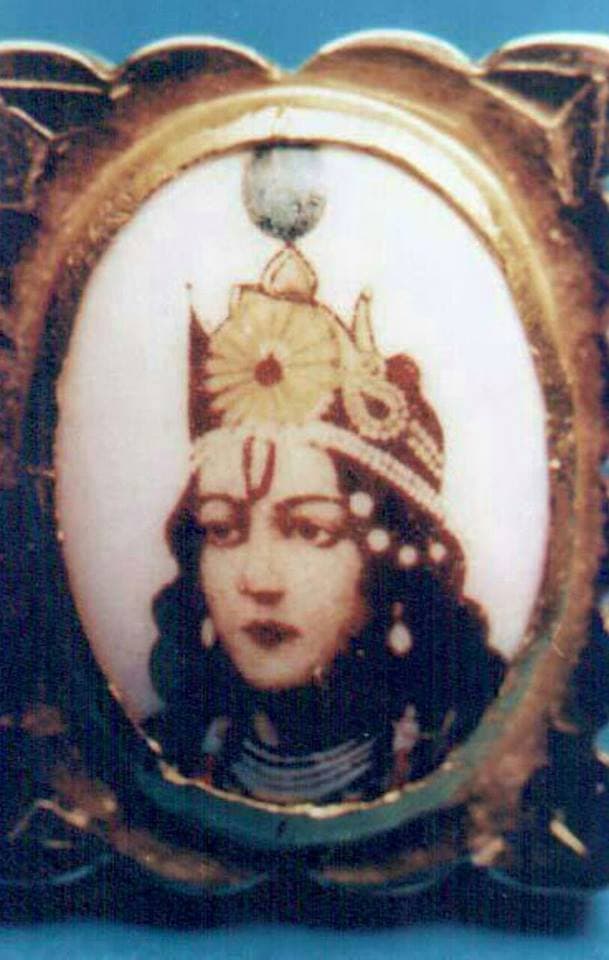
Krishna in His late teens, after the slaying of Kamsa
Swami materialised this picture set inside a gold ring, and gifted it to a devotee named Ramesh Adhikari — the husband of Bharosa, a woman whom Swami had brought back from death and whose life He went on to fill with miracles. It shows Krishna as He appeared in His late teens, soon after He slew Kamsa in Mathura.
Look closely at the oval set in gold. The turban wound around His head carries a sunburst ornament crowned with a single pearl. On His brow are the Vaishnava marks — the line of musk Swami says His parents placed there. Pearls hang from His ears, strands of beads rest against His neck, and the gaze is grave, steady and unbelievably gentle — no longer the playful child of Gokula, but the Lord who has just set Mathura free.
- Age
- Late teens
- Moment
- After the slaying of Kamsa, Mathura
- Given to
- Ramesh Adhikari, set in a ring
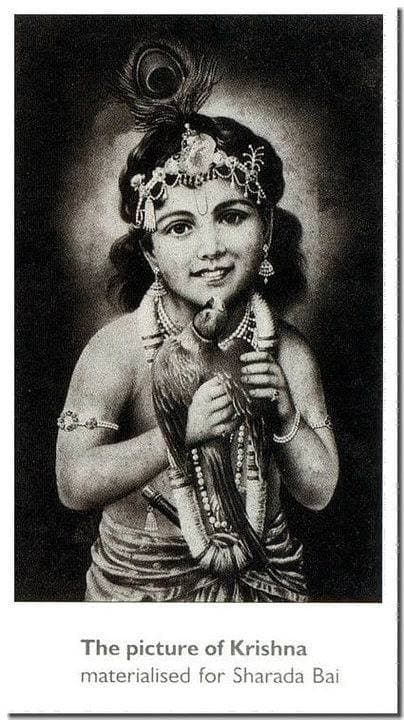
Krishna at the age of eight
This is the picture Swami materialised for a devotee named Sharada Bai — the caption printed beneath it has travelled with the photograph ever since. Here He is about eight years old: the boy of Gokula, smiling with His whole face, a parrot held tenderly against His chest.
Almost everything Swami described in His 1977 discourse can be seen here — the peacock feather tucked into the hair rather than a crown, strands of pearls across the forehead and at the ears, the bare chest with no shirt or coat, silk gathered at the waist, and on the wrists and upper arms the plain silver bangles that cowherd boys of that region wore. This is the Krishna of the butter-stealing stories — the one I grew up hearing about.
- Age
- About eight
- Setting
- Childhood in Gokula–Brindavan
- Given to
- Sharada Bai
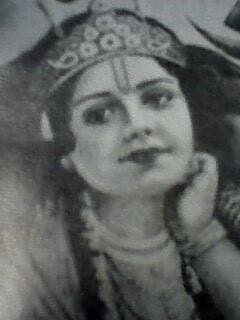
The face that many meditate upon
The third picture is a close view of His face — head resting against His hand, a crown of jewelled flowers, the upright tilak on the brow, a pearl at the ear, and a half-smile that seems to know exactly who is looking at Him.
The devotee who first gathered these pictures noted that meditation on this particular image has proven extremely powerful for many. Sit with it for a moment. If you are anything like me, you will find the eyes do not let you go easily.
- Best for
- Quiet meditation — tap to view full size
- Notice
- The tilak, the pearl ear-ring, the resting hand
How Swami described Krishna
On 6 September 1977, Swami gave a historic discourse on the divine life and times of Bhagavan Krishna. In it He spoke, with the ease of one recalling a friend, about how Krishna dressed and how He looked.
Bhagavan Sri Krishna wore a necklace of green beads, a nose ring of pearl, and on His right ear a ring of pearls. He wore no shirt or coat — just yellow silk, the pitambara, around His waist, and a turban wound around His head.
- The peacock feather that poets and sages describe was not always worn — it was occasionally tucked into the turban. Peacocks abound in Brindavan, and are plentiful there even today.
- On His bare chest there was a mole that could be clearly seen — a mark of all Avatars.
- His complexion was neither fair nor dark: three parts dark and one part fair, an amalgam of both.
- Since His parents were Vaishnavas, they placed a line of musk on the centre of His brow.
- He wore silver bangles on His wrists — the kind cowherd boys wore in that part of the country in those days.
Nila-megha-shyama — the colour of rain-filled clouds
The scriptures describe Krishna’s complexion as nila-megha-shyama — the hue of clouds heavy with rain. Look at such a cloud and you will see exactly what Swami meant: three parts dark, one part bright. He was never literally painted blue as in films and cartoons; that is an artist’s way of showing His divinity. He walked among the cowherds looking like one of them — which is why so few recognised who He was.
The bangles and the three vows
Swami also explained that the kankanas — the bangles on Krishna’s wrists — were not mere ornaments. Before any sacred undertaking — a yajna, a vow, a new stage of life — a kankana is tied to the wrist as a reminder of the resolve to see it through. Krishna had taken three vows, and the bangles He wore were the sign of His determination to fulfil them. He states them Himself in the Gita:
- 1
Dharma-samsthapanarthaya sambhavami yuge yuge
I shall incarnate in every age to revive Dharma.
- 2
Yoga-kshemam vahamyaham
I shall bear the burden of the peace and prosperity of all who rely on Me.
- 3
Mokshayishyami ma shuchah
I shall save all who surrender wholeheartedly to Me, and free them from the cycle of birth and death.
Closer to us than we think
Swami placed Krishna’s advent about five thousand years ago, and Rama’s about twenty thousand years ago — a gap of fifteen thousand years between the two forms. Really speaking, Krishna’s time is closer to us than it ever was to Rama’s.
God is beyond all form — Swami has told us this again and again. And yet, to glimpse the face of the One I have loved since I was a child, brought forth by the very hands I pray to, is a gift I did not expect and will never forget.
Sai Ram.
The pictures and the excerpts from Swami’s discourse in this article were first gathered by Dr. Vinnith Pullavarayar on his blog Mayiliragu — Actual picture of Lord Krishna. Shared here with gratitude.